
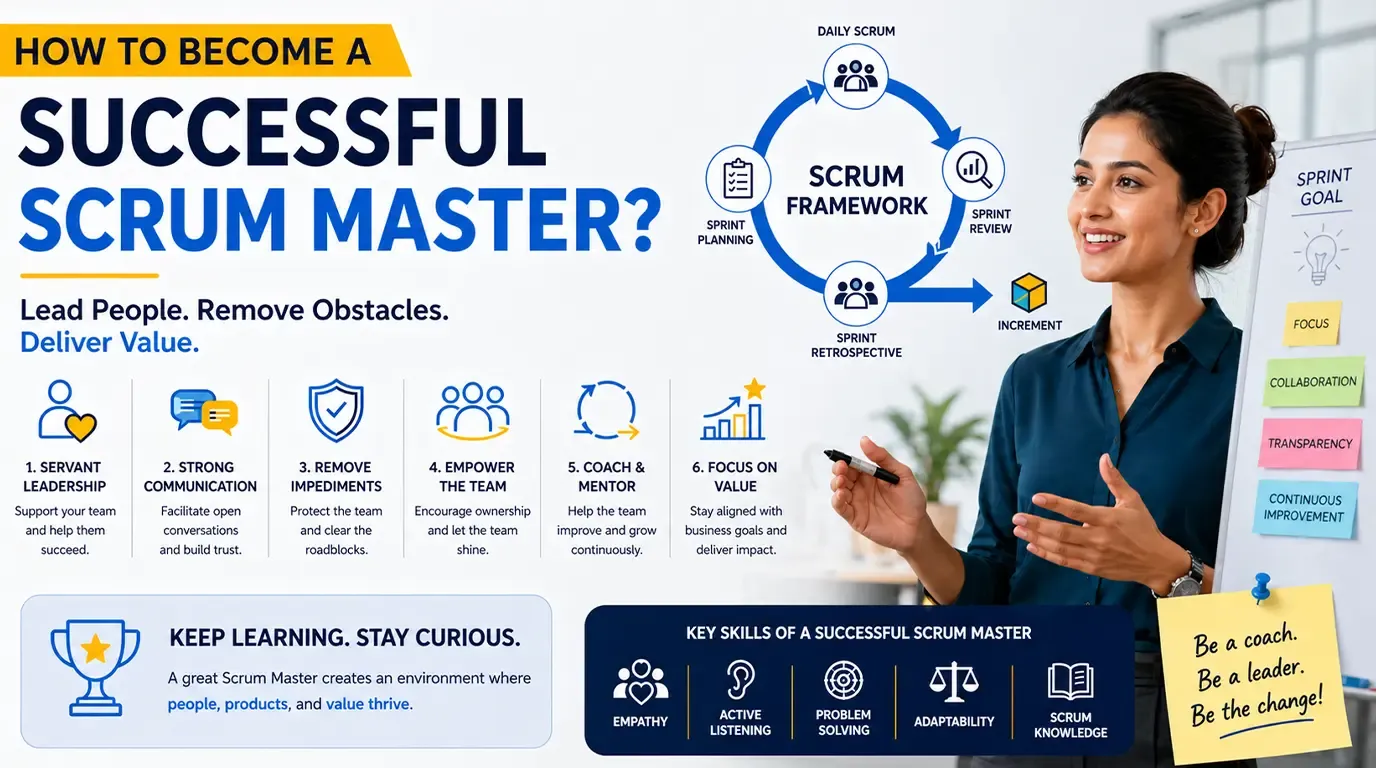
Understanding The Scrum Master Role
What Is A Scrum Master?
So, what exactly is a Scrum Master? Think of them as the team’s guide and protector within the Scrum framework. They aren’t a traditional manager telling people what to do. Instead, they’re there to help the team understand and use Scrum effectively. Their main job is to make sure the Scrum process is followed and that the team can do its best work. They help everyone involved, both inside and outside the team, understand how to interact with the Scrum team in ways that actually help, not hinder, the creation of value.
The Core Responsibilities Of A Scrum Master
The Scrum Master has a few key areas they focus on:
- Helping the Team: This involves coaching team members, removing roadblocks (impediments), and making sure the Scrum events like daily stand-ups, sprint planning, reviews, and retrospectives run smoothly and are productive. They also help the team become more self-organizing and take ownership of their work.
- Supporting the Product Owner: The Scrum Master works closely with the Product Owner to make sure the product backlog is well-defined and understood by the team. They help bridge the gap between the Product Owner’s vision and the development team’s execution.
- Organizational Help: They act as a change agent within the wider organization, helping others understand Scrum and how to best work with Scrum teams. This can involve educating stakeholders and removing organizational impediments that slow the team down.
Essentially, the Scrum Master is a servant-leader, focused on the needs of the team and the organization to help them achieve their goals through the Scrum framework.
Cultivating Essential Scrum Master Qualities
So, you want to be a great Scrum Master? It’s not just about knowing the rules of Scrum; it’s about having a certain set of personal qualities that help your team thrive. Think of it like being a good coach – you need more than just knowing the playbook.
Embrace Servant Leadership
This is a big one. Servant leadership means you put your team’s needs first. Your job is to help them succeed by removing roadblocks and supporting their growth. It’s about serving the team, not the other way around. You’re there to help them do their best work, plain and simple. This approach helps build trust and makes the team feel supported.
Develop Strong Coaching Abilities
As a Scrum Master, you’re often guiding people. This means you need to be good at coaching. You’re not telling people what to do, but rather asking questions that help them find their own solutions. It’s about helping individuals and the team improve their skills and processes. Think about helping a team member figure out a tricky problem themselves, rather than just giving them the answer. This builds their confidence and problem-solving skills.
Master Facilitation Skills
Meetings can be a drag if they’re not run well. Your role is to make sure Scrum events, like the Daily Scrum or Sprint Retrospective, are productive and useful. This means keeping discussions on track, making sure everyone gets a chance to speak, and helping the group reach a clear outcome. A well-facilitated meeting feels like progress, not a waste of time. You’re the one who makes sure these gatherings actually help the team move forward.
Foster Effective Communication
Good communication is the glue that holds everything together. You need to be able to talk clearly with your team, the Product Owner, and even people outside the team. This involves listening well, too. When you communicate openly, it helps prevent misunderstandings and keeps everyone on the same page. It’s about making sure information flows smoothly so the team can do its job without unnecessary confusion.
Driving Team Success Through Agile Principles
Being a Scrum Master means you’re not just a meeting facilitator; you’re a coach and a guide for the team, helping them really live and breathe agile. It’s about making sure the team understands why they’re doing things, not just how. This means championing the Scrum framework itself, making sure everyone gets it and follows it, but also knowing when and how to adapt it. The goal is to create an environment where the team can do its best work, consistently.
Championing The Scrum Framework
Think of the Scrum framework as the team’s operating system. It’s designed to help teams work effectively, especially in complex environments. Your job is to make sure everyone understands the rules of this system – the roles, events, and artifacts. But it’s more than just knowing the rules; it’s about understanding the spirit behind them. This means helping the team see how Scrum helps them deliver value and adapt to change. You’re the one who can explain why a Daily Scrum is important for coordination or why a Sprint Review is the perfect time to get feedback from stakeholders. It’s about making the framework work for the team, not against them. You can find more about the core ideas behind Scrum on the official site.
Ensuring Scrum Events Are Effective
Scrum has specific meetings, or events, built into it: the Sprint Planning, Daily Scrum, Sprint Review, and Sprint Retrospective. These aren’t just time slots to fill; they have a purpose. Your role is to make sure each event achieves its goal. For example, Sprint Planning should result in a clear Sprint Goal and a plan for the work. Daily Scrums should be short, focused updates that help the team identify impediments. Sprint Reviews are for inspecting the increment and adapting the Product Backlog. And the Sprint Retrospective is where the team looks back at their process to find ways to improve. If an event isn’t working, it’s your job to figure out why and help the team adjust. It might mean changing the format, the timing, or even the attendees.
Encouraging Team Ownership And Self-Organization
Great Scrum Masters don’t tell the team what to do; they help the team figure it out for themselves. This is the heart of self-organization. It means the team decides how best to do their work, how to solve problems, and how to manage their own tasks. Your job is to create the conditions for this to happen. This involves:
- Providing clear goals and boundaries.
- Removing obstacles that prevent the team from making decisions.
- Trusting the team’s ability to find solutions.
- Celebrating when the team takes initiative and solves problems independently.
When a team owns its work, they’re more invested and more likely to find creative solutions. It’s about shifting from a command-and-control style to one of support and guidance.
Navigating Team Development Stages
Teams don’t just magically become high-performing. They go through stages, much like people do. Understanding these stages, like Tuckman’s model (Forming, Storming, Norming, Performing), helps you know what the team needs at different times. In the ‘Forming’ stage, they’re just getting to know each other. In ‘Storming,’ conflicts might arise as personalities clash and ideas are debated. ‘Norming’ is when they start to figure out how to work together smoothly, and ‘Performing’ is when they’re a well-oiled machine. Your role changes depending on the stage. You might need to be more directive in the early stages and more of a facilitator as they mature. Recognizing these phases helps you provide the right kind of support, whether it’s helping resolve conflicts or encouraging collaboration. It’s about guiding them through the bumps and helping them reach their peak performance.
Continuous Improvement For Scrum Masters
Being a Scrum Master isn’t a ‘set it and forget it’ kind of gig. The whole point of Scrum is to get better over time, right? Well, that applies to you as the Scrum Master too. You’ve got to keep learning and tweaking how you do things. It’s not about being perfect from day one, but about always looking for ways to be more helpful to your team and the whole organization.
Commit To Lifelong Learning
The world of agile and Scrum is always shifting. New ideas pop up, tools change, and people figure out better ways to do things. You can’t afford to stand still. Think of it like this: if you stop learning, you’re basically falling behind. It’s not just about reading books or taking courses, though those are good. It’s about being curious. Ask questions. Pay attention to what’s happening around you. What worked well last sprint? What didn’t? Why?
- Read articles and blogs about Scrum and agile.
- Attend webinars or local meetups.
- Experiment with new techniques in your team’s retrospectives.
Be Open To Feedback
This one can be tough sometimes, but it’s super important. You’re there to help the team, and they’re the ones doing the day-to-day work. They’ll see things you don’t. So, you really need to be ready to hear what they have to say, even if it’s not always easy to hear. This means actively asking for feedback, not just waiting for it to come to you. And when you get it, really listen. Don’t get defensive. Try to understand their perspective.
- Ask your team directly: “What could I do better to support you?”
- Observe how your team interacts with you and each other.
- Be willing to change your approach based on what you learn.
Leverage Retrospectives For Growth
Retrospectives are gold. Seriously. They’re built into Scrum for a reason – to give the team a chance to pause, look back, and figure out how to improve. As the Scrum Master, it’s your job to make sure these meetings are actually useful. Don’t just go through the motions. Make sure everyone feels safe to speak up. Try different ways to run the retrospective so it doesn’t get stale. Maybe one time you focus on what went well, another time on what was difficult. The goal is always to come out with actionable steps for the next sprint.
Adapt To Evolving Methodologies
Scrum is great, but it’s not the only way to do things, and even Scrum itself has variations and new ideas coming out all the time. You might work with teams using Kanban, or maybe a hybrid approach. Your job isn’t to force everyone into a rigid box. It’s to understand the principles behind agile and Scrum and help the team find the best way to work for them. This means being flexible and willing to learn about different frameworks and practices. What works for one team might not work for another, and that’s okay. Your ability to adapt will help your team stay effective, no matter what changes come their way.
Building Strong Relationships
Being a Scrum Master isn’t just about the mechanics of Scrum; it’s a lot about people. You’re kind of the glue that holds things together, and that means you need to be good at connecting with everyone involved. Your ability to build and maintain strong relationships is key to a team’s success.
Collaborate Effectively With Product Owners
The Product Owner (PO) is the one who decides what the team builds. They’re the voice of the customer and the business. You and the PO need to be on the same page. It’s not about being best friends, but about having a solid working relationship where you can talk openly.
- Understand their goals: What are they trying to achieve with the product? What’s most important right now?
- Communicate clearly: Make sure they understand what the team can realistically do and what might be challenging.
- Support their decisions: Even if you don’t always agree, you need to back them up to the team, while also helping them see different perspectives.
- Regular check-ins: Don’t wait for problems to pop up. Have regular chats to talk about the backlog, upcoming work, and any concerns.
Engage Deeply With Your Team
This is where you really get to know the people you’re working with every day. It’s more than just watching them code or do their tasks. It’s about understanding their individual strengths, how they work together, and what makes them tick.
- One-on-one conversations: Regularly talk to each team member. Ask how they’re doing, what’s on their mind, and if they need any support. This isn’t a performance review; it’s just connecting.
- Observe team dynamics: Pay attention to how people interact. Who helps who? Are there any quiet members who need a nudge to speak up? Are there any clashes happening?
- Be approachable: Make sure the team feels comfortable coming to you with problems, big or small. You’re there to help them remove roadblocks.
- Celebrate wins: Acknowledge when the team does something great. It builds morale and shows you notice their hard work.
Build Influence At The Organizational Level
Your job as a Scrum Master doesn’t stop at the team’s door. You often need to work with people outside the immediate team – managers, other departments, stakeholders. This can be tricky, but it’s important for the team’s environment and for Scrum to work well.
- Educate others: Many people in an organization don’t fully understand Scrum or Agile. You’ll need to explain it, not in a preachy way, but by showing the benefits.
- Remove organizational impediments: Sometimes, the team’s progress is blocked by things outside their control, like slow approval processes or conflicting priorities from other departments. You need to work with others to fix these.
- Advocate for the team: When necessary, you might need to speak up for the team’s needs or protect them from unreasonable demands. This builds trust.
- Share successes: Let people know when the team is doing well and what they’re achieving. This helps build a positive reputation for Agile practices within the company.
Achieving Mastery In Your Scrum Master Journey
So, you’ve been doing the Scrum Master thing for a while now. You’re comfortable with the ceremonies, you can spot a bottleneck from a mile away, and your team generally likes you. That’s great! But what’s next? How do you go from just ‘doing’ Scrum Master to actually mastering it? It’s a journey, for sure, and it’s not always about big, flashy changes. Sometimes, it’s the small, consistent efforts that make the biggest difference.
Consider Scrum Master Certification
Look, I know some people roll their eyes at certifications. “Do I really need a piece of paper to prove I know how to help a team?” Maybe not, but hear me out.
Getting certified, especially through reputable organizations like Scrum.org or Scrum Alliance, forces you to really dig into the framework. It’s not just about memorizing terms; it’s about understanding the ‘why’ behind everything. Plus, it can open doors and give you a solid baseline of knowledge that others recognize. It’s like getting a driver’s license – you might know how to drive, but the license shows you passed a test and know the rules of the road.
Take the next step in your agile career with expert-led Scrum Master Certification training from Certlyx. Learn Scrum principles, master team leadership, and prepare for certification with live sessions, practical guidance, and flexible learning options.
Enroll Today and Lead High-Performing Agile Teams with Confidence.
Develop Analytical And Problem-Solving Skills
This is where the rubber meets the road. Anyone can follow a checklist, but a true Scrum Master can look at a team’s performance and see what’s really going on. Are the daily stand-ups dragging because people aren’t prepared, or because there’s a deeper issue they’re afraid to bring up? Are retrospectives producing actionable items, or just a list of complaints that get forgotten? You need to get good at spotting these patterns. Think of it like being a detective for your team’s workflow. You gather clues (observations, data from sprint reports, team feedback) and then figure out the best way to solve the puzzle.
Cultivate Confidence And Courage
This one’s a biggie. You’re going to encounter situations where you need to speak up, even when it’s uncomfortable. Maybe it’s an impediment that’s outside the team’s control, or maybe it’s a stakeholder who’s not respecting the process. You need the confidence to voice concerns and the courage to stand firm when necessary. This doesn’t mean being aggressive; it means being assertive and believing in the value of Scrum and your role in protecting it. Remember, courage is one of the core Scrum values for a reason.
Lead By Example
This is probably the most important point. You can’t expect your team to be transparent, committed, or respectful if you’re not. Live the values you preach. Show up prepared for meetings, admit when you make a mistake, and always be looking for ways to improve yourself and the team. Your actions speak louder than any words or certifications. If you’re constantly learning and adapting, your team is more likely to do the same. It’s about being the kind of person you’d want to work with.
Wrapping Up Your Scrum Master Journey
So, becoming a great Scrum Master isn’t just about knowing the rules of Scrum. It’s more about how you work with people. Think of it like being a coach, a helper, and a bit of a detective all rolled into one. You’ll need to be good at talking, listening, and figuring out what makes your team tick. Keep learning, stay open to new ideas, and don’t be afraid to try different things. It takes practice, sure, but by focusing on helping your team succeed and grow, you’ll find your way to being a really effective Scrum Master. It’s a rewarding path, and the impact you can have on a team is pretty significant.
Frequently Asked Questions
What exactly does a Scrum Master do?
Think of a Scrum Master as a coach and helper for a team that uses Scrum to get work done. They make sure the team follows the Scrum rules, helps them work together better, and removes any roadblocks that get in their way. They don’t tell people what to do, but rather help the team figure things out for themselves.
What are the most important qualities for a Scrum Master?
A great Scrum Master is a good listener, a strong communicator, and a natural leader who puts the team first. They also need to be good at helping the team solve problems, stay motivated, and learn from their mistakes. Being adaptable and always wanting to learn new things is super important too.
Why is being a ‘servant leader’ important for a Scrum Master?
Servant leadership means the Scrum Master’s main job is to help the team succeed. They focus on supporting the team members, removing anything that slows them down, and making sure everyone has what they need to do their best work. It’s about serving the team, not being the boss.
How does a Scrum Master help the team improve?
Scrum Masters help teams get better by encouraging them to talk openly about what’s working and what’s not, especially during meetings called ‘retrospectives’. They also help the team learn from their experiences and try new ways of working to become more efficient and effective.
Do Scrum Masters need special training or certifications?
While you don’t absolutely need a certificate to be a Scrum Master, getting one can show you really understand the Scrum rules and how to use them. It’s a good way to prove your skills and can help you learn even more about being a great Scrum Master.
How does a Scrum Master build good relationships?
A Scrum Master builds strong connections by talking regularly with the team and the Product Owner, understanding everyone’s strengths, and helping them work together smoothly. They also work to build trust and good relationships with others in the company to help the team succeed.